
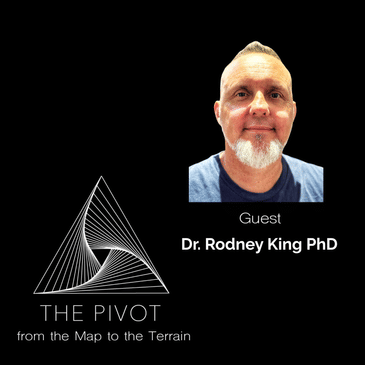
Dr. Rodney King has navigated some of the hardest terrain a person can cross — homelessness on the streets of Johannesburg, a health crisis that ended his career, and the disorienting question that follows when everything you've built around yourself falls away: who am I now?
He came out the other side not with a framework, but with a direction. As a philosopher, coach, and founder of Coaching Philosophia, Rodney now works with people navigating the meaning crisis — the growing gap between what modern life promises and what it actually delivers.
In this conversation, Dave and Rodney get into why the modern world has confused excelling with flourishing. Why the self-help industry is largely a repair mechanism for a broken environment. Why you can be content without being happy. And what it actually looks like to find your way back to something real.
This isn't an optimization conversation. It's a return one.
About This Episode
Dr. Rodney King is a philosopher, coach, and internationally recognized self-preservation expert. Originally from South Africa, he spent decades as a martial arts coach with programs in 15 countries — working with everyone from Tier One Special Forces operators to airline cabin crew. A health crisis in 2020 ended that chapter and opened a new one.
He now lives on the Isle of Man and works under the banner of Coaching Philosophia — bringing lived philosophy, mindfulness, and embodied practice to people navigating uncertainty, reclaiming meaning, and learning to flourish in a world that has largely forgotten how.
What We Explored
The modern world has confused excelling with flourishing. Rodney had the car, the house with the right zip code, the global travel. He'll tell you directly that wasn't the best time of his life.
The self-help industry is largely a repair mechanism for a broken environment. When the chimp is rocking back and forth in the zoo, the problem isn't the chimp. It's the zoo. We've built an unnatural environment, normalized it, and then told people to optimize their way through it.
The meaning crisis is real - and it's structural. We are running ancient hardware in an artificial environment. The evolutionary mismatch between what we're designed for and what modern life asks of us is showing up everywhere.
Happiness and contentment are not the same thing. The Western obsession with constant happiness may be doing significant damage. Contentment is something you can actually build. Happiness comes and goes.
Vulnerability as a practice — from someone who spent his career in a world where it was seen as weakness. Rodney's move from fighter to philosopher-coach carries real weight here.
Viktor Frankl on the streets of Johannesburg. The book ("Man's Search for Meaning" ) Rodney happened to pick up two weeks before becoming homeless — and the passage that kept him going.
A Line Worth Sitting With
"Everything the self-help world advocates as solutions are really just solutions to help you slot back into the mainstream and keep the machine going. And I don't think that's good for us." — Dr. Rodney King
🔗 CONNECT WITH RODNEY Search for Sophia bi-monthly calls: https://www.coachingphilosophia.org/searchforsophia Philosophy-inspired coaching: www.coachingphilosophia.org/coaching
🔗 CONNECT WITH DAVE Website: daveschoof.com | Newsletter: https://tinyurl.com/4vn8832a
Substack: https://dschoof.substack.com | Podcast: https://thepivotpodcast.net/?v=zm7s |
LinkedIn: https://www.linkedin.com/in/daveschoof/
[00:00:00] Everything that we are told pits us against each other. You know, we are told to compete, to win at any cost, to focus on material gain. If I ran a zoo, I'd rather see animals free and wild, just like us. And I had chimpanzees, and one of my chimpanzee was displaying behaviors that concerned me. You know, rocking back and forth, doing things that just, I would say, this chimp does not look right.
[00:00:26] And I called in a zoologist, somebody who knew more than I knew, and I was like, what's going on here? That person's not going to turn around and say, oh, there's a problem with the chimp. What they're going to say is, no, actually, there's a problem with the environment. Yep. Welcome to The Pivot, where we explore the shifts that open new possibilities for how we see, act, and navigate the world.
[00:00:51] Right now, so much is changing, faster than we can make sense of. It's easy to feel unmoored, caught between an unraveling past and a future that's still, well, taking shape. But there are those who can already see what's emerging, beyond the noise, beyond the confusion. In each episode, I sit down with visionaries, thinkers, practitioners, and pioneers who are not just imagining the future, but actually living it.
[00:01:21] They're sensing what's next and mapping the way forward. So if you're wondering how to navigate this shifting landscape, how to stay grounded, adapt, and even thrive, you're in the right place. This is not about quick fixes or the seven steps to be more effective. This is about asking the right questions of yourself, of each other, of life. Learning how to make sense of this changing terrain and how to move in it.
[00:01:50] You don't have to figure it out alone. I've got you covered. This is The Pivot. Welcome. Hi. Today's guest is Dr. Rodney King. Rodney spent decades teaching people how to survive, first on the mat as one of the world's most recognized martial arts coaches, with programs in 15 countries and clients ranging from Tier 1 Special Forces to airline cabin crews.
[00:02:20] Then, a health crisis ended that chapter. And a new one opened. Rodney is not the kind of guest who shows up with a framework or a tidy answer or the seven steps to something. He's a philosopher and a coach who will tell you directly, he hasn't got it all figured out. He's got cracks. There are days when it all works and days when it doesn't.
[00:02:48] And that honesty, coming from someone who built his career in a world where vulnerability was considered a weakness, is exactly what makes this conversation worth listening to. We get into the difference between happiness and contentment, into what Rodney calls unoptimized moments, and why the inability to take a purposeless walk tells you more about your conditioning than any assessment could.
[00:03:19] We talk about the psilocybin journey that pointed him towards Sophia, the ancient figure of wisdom, and how that experience only made sense years later. And we talk about whether what's needed now is something new or a return to something we've spent years covering over. Rodney is not a comfortable thinker. He's a frontier one. And that's why he's here.
[00:03:51] Let me give a note. There was a little bit of audio interference in the beginning of this recording, but I think it's worth sitting through. Let's get to it. Rodney, welcome. Thank you for being here. Well, thank you for having me. Appreciate it. Yeah. Maybe as a way to start, what would you like people to know about you? Geez, how long do you have? We can go.
[00:04:14] Well, look, currently I live on the Isle of Man, which most people have no idea where it is when I tell them. So it's in the middle of the Irish Sea between England and Ireland. You went on Google Maps, right? And you started like zooming in and kept zooming in. And eventually you'd see a little dot in the Irish Sea. That's the Isle of Man. I live now, but I'm originally from South Africa.
[00:04:40] So I moved here in January 2020, just before the whole COVID thing happened. And I haven't left since then. It's got to be pretty small. It's small, but very much a different change of pace because I lived in Johannesburg. So that's a pretty big city, fast-paced city. Yeah. Probably the most stress I would have is I'm trying to get somewhere on time.
[00:05:07] And I met with a flock of sheep crossing the street, right? Like a traffic jam of sheep. That's probably like the biggest, biggest stress I would have in a week. So no complaints, right? Sounds fantastic. And tell us about what you like to do for work, what your vocation is. So that's changed, right? I'm kind of shifting gears. And I know we've spoken before, so you know a little bit about this. But originally what I was as a martial arts coach.
[00:05:37] And so I spent a few decades teaching martial arts, traveling around the world. I created a couple of programs that, well, back when they kind of launched and kind of went global, you know, we would say today, oh, they went viral. And at its peak, it was in 15 countries around the world.
[00:05:57] So I was traveling, teaching seminars, working with everybody from tier one special force military operators, law enforcement teams, teaching defensive tactics, all the way to airline tavern crew and the everyday person. So that's my original kind of vocation, if you want to call it that. And then around about, it was already starting a few years before I got here in 2020.
[00:06:22] I basically had a health crisis that floored me and took my feet right from underneath me. I was lucky to be on the Isle of Man when that really happened. So at least there was a place where I had the opportunity to try to work through it and recover. And coming out of that, I've shifted gears into what I would call philosophy-inspired coaching.
[00:06:45] So I'm taking, you know, much of what I did throughout my years as a martial arts teacher and coach and taking those coaching aspects that I utilized all the time on the mat with my students. And looking at how that can be applied in helping people navigate existential crisis. Which, for me, that was a big thing. In hindsight, when I look back, it's kind of weird, right?
[00:07:10] I don't think all experiences are like this, where you can say every bad thing that happens to you is a teaching moment, right? Some things are just bad and they happen and there's really no reason behind them. But this time, for sure, looking back, even though it didn't feel like it at the time, my health crisis was probably the catalyst that I needed to shift into the direction where I'm going now.
[00:07:34] Because I had to ask myself some really deep existential questions where I basically curated my entire existence around this idea of being a martial arts teacher. That's what I was known for. That was what most people look to me towards. And now suddenly that was gone and I no longer had that. So who am I, right? And now if I can't do what I'd always done and what had always been my passion. Actually, because I started training martial arts when I was six years old.
[00:08:02] So it was a part of my life that was suddenly taken away from me and I was told in no uncertain terms, look, you can't do this anymore. You need to start thinking about finding a different way to show up in the world. And that obviously means what you do for a living, right? And what you do as a profession. So in hindsight, it was actually a positive thing because I don't think I would be where I am now and doing what I'm doing now had that not happened to me. Isn't it something when you can look back and see the elegance of that unfolding?
[00:08:33] I think it is. But I always want to like situated, right? Because I kind of hinted to that already. But I also want to be clear that in my experience, like, you know, bad things happen to all of us, right? Shitty things. I don't think everything's a teaching moment. Sometimes it's just crap happens, right? It just does. And it is what it is. And I think that in itself is an existential moment to recognize that that's just the way life is. That there's going to be good times.
[00:09:02] There's going to be tough times. But even in the tough times, I think you can find contentment. You might not be happy, but you can be content, right? And so, you know, I think that's crucially important because I think too often in our modern society, there's this narrative that, oh, you know, everything that happens to you happens for a reason. And there's always this teaching moment. And I think, of course, there is. And in this instance, I can agree with that. But there have been many other experiences in my life when that hasn't been the case.
[00:09:32] And that's okay, too. You know, that's okay. I think that's important because I feel oftentimes we've been sold this narrative, especially in the West, where there's constant search for happiness, right? You have to be happy all the time. I don't think that's possible. And I don't think that's realistic. I think you can be content, but I don't think you can be happy all the time. I think happiness comes and goes.
[00:09:58] You know, there's moments of happiness and then there's moments of grief and despair. But you can be content with your life. And I think that's a more productive way to kind of navigate your life's journey. Yeah, I totally agree. And I think you're bringing in an important distinction around not everything is that you're going to turn rosy, kind of that fairy tale piece that is very prevalent in the West, isn't it? Certainly for a long time.
[00:10:27] When you think back, looking back now, of course, it's easier, right? But was there something that helped you discern this is different than that? Like this one? Oh, yeah. No, this one has meaning. There's something in this beyond just having to adapt to a new life or disidentify with what was happening for you up to that point. That's a good question. I think there's a few things here that stand out for me.
[00:10:51] But I think for one, it was at a time when it happened that I was already not entirely happy with the direction that my life was going. So I guess what I'm saying there is that had this not happened, I might have just stayed on the path that I was on, maybe created more damage to what I already did or kept pushing through even though I didn't really want to be there anymore.
[00:11:17] Because I wanted to have a more fuller experience of what I was doing. I wanted more than just teaching people how to fight, right? Yeah. That's definitely one strand.
[00:11:27] I would say another strand would be that I had a few experiences, psychedelic experiences with mushrooms, with psilocybin, that were pivotal moments in me reassessing who I was, who I wanted to be.
[00:11:50] And gave me an opening, a look into a side of existence that maybe wouldn't have been available to me in any other form. I'll give you an example of what I mean by this. So there was one time where I had done a certain amount of psilocybin. All I can say is that for the first several hours, it was the dark night of the soul.
[00:12:17] It was a term of bad trip and it was bad. And I was fighting all the way through that trip, not wanting to concede what was being shown to me. Only when I relinquished and I said, okay, you know what? You win. You win. I'm not going to fight this anymore because clearly I'm not winning, right? I was just getting beaten up. Suddenly the entire experience changed.
[00:12:39] And it was only later on as I reflected back on it that I realized that there was this, what I can only describe as a feminine energy that came in this experience. And when I looked back now, I recognize it as Sophia, as the goddess of wisdom, which if you think about what I've just been saying and I've kind of moved more into kind of philosophical coaching, that makes a whole lot of sense, right?
[00:13:06] Because philosophy, the original word for philosophy is the love of wisdom, you know, the search for wisdom. And so it was almost foretelling the future, but I hadn't gotten there yet, right? So initially when this experience happened, I was like, I have no idea what this means.
[00:13:23] And it was only a few years on as just certain things kind of started colliding, you know, be it whatever you want to say, divine intervention, that I suddenly found myself in this space realizing that's exactly what I was, what that moment, that teaching moment, what it was trying to show me. And that was very, very powerful because then I realized that the direction that I was going in was the path that I was meant to be on.
[00:13:52] You know, so again, had I not had the health crisis, I wouldn't have done the psychedelic experience because I was looking for answers and I was looking for ways to heal. If I hadn't have done the psychedelic experience, I may have not recognized the direction I needed to go. So for all I know, I might have still, like I said earlier on, I might have been able to push through things and just keep to the old way of doing things, even though it wasn't serving.
[00:14:19] So I'm not sure if that answers your question, but I think that's kind of... I think it does. I think there's a lot of wisdom in here to tease out, you know, one is like how to differentiate this. Why was this one different than something that just was bad and tragic, right? And, you know, a couple of things that ring out to me is there was this disquiet, you know, already kind of a questioning. And then it got ramped up, you know, to here's an opportunity to address it. And, you know, there was a choice point at some point.
[00:14:47] It may not have felt like a choice, but there was, you know, two different paths that you could have gone on. And so that tells me you're responding to some sort of call, right? And I don't know about you, but I noticed that these calls are often very quiet in the beginning. And if I ignore them, they get a little bit louder over time. But there was something. And then, you know, the psilocybin, the psychedelic experience, that enhances the imaginal. So it's no longer, you know...
[00:15:17] It's the mythic experience. Brings the myth back into the existence. Something that you might have not even looked at at any point in time, but suddenly there it is, right? And of course, you know, as most people will know if they've done these kinds of experiences, is that it's one thing having the experience, but then it's very important afterwards to integrate this, right? And I think, you know, sometimes you need a guide. You need somebody to guide you to do that because I don't think it's always that easy.
[00:15:47] For people to integrate the experience. I think I was lucky because of my background and just all the things that I experienced in my life, that I was able to, you know, over time, slowly figure out what the meaning was behind this and what it actually meant and which direction I needed to go. But yeah, absolutely. I mean, I would say that that was a pivotal moment because I don't think if I'd had that experience, I would have been where I am now. I suppose if somebody's listening to this and they're saying, well, kind of Rodney's being a little...
[00:16:16] What are we talking about? Yeah, right. So bottom line was I would diagnose with severe cervical degen in my neck. So basically, you know, all my vertebrae in my neck are basically almost gone, which was giving me, and still even now, cervogenic headaches. I would just constant headaches all the time, nonstop. Every day was just fighting headaches. Then on top of that, a lot of the symptoms that you have is CTE related.
[00:16:45] So that's like just taking enormous amount of punishment to the head over the years, right? Concussions and things like that. Because of the martial arts, I mean, I did tens of thousands of hours of sparring, full contact, right? I was struggling with ME or chronic fatigue syndrome. So it was just a whole bunch of things happening all at the same time. You can't keep going.
[00:17:09] And suddenly to go from being in the best shape of my life, physically all day doing stuff, challenging myself all the time to basically zero, doing absolutely nothing, or unable to do much other than maybe going for a walk. That was a very hard pull to swallow. And it took me some time to work through that. But I will say as well is that, again, coming back to the kind of existential frame,
[00:17:37] is that I also realize in that time period how important, and I've known this, but you need something sometimes this dramatic to actually make you really understand how important meaning is to us as human beings. I mean, I would make the argument that we are meaning creating entities. And without meaning, it's very difficult for us to flourish.
[00:18:02] And so finding new meaning was a very, very important part of me getting back on the path to some kind of normality. I'm not 100% healed, but just having the sense of meaning and purpose back in my life has been really important. Yes, absolutely. Well, first of all, thank you. I mean, this is an incredible story and I appreciate the sharing and the vulnerability of this.
[00:18:29] You know, so many of us talk about turning points and the struggle of, you know, we're identified with our role in life or the way life goes. But, you know, what you've experienced is not just an adjustment, but a disintegration of, you know, everything that you would identify with. And, you know, you were talking about meaning. And I immediately went to Viktor Frankl and man's search for meaning. And, you know, you're right.
[00:18:56] We are, not only are we meaning making, but we, that's what nourishes us. Yeah, yeah. It's interesting that you mentioned Frankl. So I have a story there as well. So I grew up on the south side of Johannesburg. So that's like government housing. It's like the, it's the project. It's like the projects in the United States is the only way that I can say it's a similar experience. So I grew up relatively poor and my mother, I was brought up by a single parent.
[00:19:24] My mother was a raging abusive alcoholic. I mean, so much so to the point that when I was 17, she kicked me out of the house and I found myself sleeping on the inner city streets of Johannesburg. So I was homeless for a while. And talking about Viktor Frankl, the interesting thing about this is another moment, right? Where just literally two weeks before, for some weird reason, I had picked up his book, Man's Search for Meaning.
[00:19:51] And I'd been reading that book and that passage has always stood out for me, which is one of his most famous quotes, right? The loss of human freedoms is your ability to choose your own given attitude in any set of circumstances. And I kept that with me the whole time that I was homeless because that was the thing that kept running through my mind. You know, that, that yes, things are really bad right now. It sucks. And I don't know where my next meal is going to come from. I don't know what tomorrow is going to bring.
[00:20:21] And I'm not going to lie. I was, I was shattered and I was afraid, but I was like, I got to just change my attitude about this. I've got to find a way through this. And so that, that kind of moment of resilience and fortitude that I discovered on the inner city streets of Johannesburg being homeless was definitely something that was profound in my own journey as I became a martial arts teacher later on, because I, you know, I drew on that, right?
[00:20:49] Then my capacity to look back and go, you know what, actually you've, you've survived some really hard times and you found a way through it. Yes, indeed. You know, this is one of the reasons why I wanted to do this with you and explore, because when we connected, first of all, there was an immediate connection. And then I recognized you as someone who's, who knows how to navigate, you know, when there's no map, there's just no way to do this.
[00:21:17] And I think it's, this was the other point that we had in common is, is talking about, you know, the metacrisis, the existential risks that, you know, we're trying to navigate and learn how to move through. And you, you've learned how to do that under incredible circumstances. You know, I consider you one of the, I call it the edge thinkers you've, you've navigated. And maybe this is a way to bring in, you know, some of the work that's emerged for you, expressed
[00:21:45] through you because of this. Yeah. So, so one of the things that I'm focusing on now, sometimes I'll ask myself why, but you know, I'm in, I'm in the midst of a second PhD. So I decided to go do a second PhD, but I'm really interested in what has been termed the crisis of meaning, the meaning crisis in the contemporary world. I feel it's real.
[00:22:13] I feel the conversations that I have with people suggest that it is. My thoughts on it presently, and that may change, of course, but a realization that the way that the modern world is structured and what it asks from us as individuals is corrosive to this idea of existential flourishing, right?
[00:22:38] Or being, you know, even just flourishing in of itself, showing up and being your best. Because everything that we are told pits us against each other. You know, we are told to compete, to win at any cost, to focus on material gain. You know, all of these things, I think, are contributors to the mental health crisis that we see underway, specifically in the West.
[00:23:07] But I would say anywhere where the industrialized hand has touched. My kind of analogy for this would be something like, if I ran a zoo, I'd rather see animals free and wild, just like us, wild and free, like Henry David Turow would say, right? But if I had chimpanzees, and one of my chimpanzees was displaying behaviors that concerned me, you know, rocking back and forth, pulling out fur, you know, just digging into himself,
[00:23:36] just doing things that just, I would say, this chimp does not look right. And I called in somebody like a zoologist, somebody who knew more than I knew. And I go, what's going on here? That person's not going to turn around and say, oh, there's a problem with the chimp. What they're going to say is, no, actually, there's a problem with the environment. Yep. The systems. The environment, the structural base that this animal finds itself in is creating this malaise.
[00:24:04] So if we use that same analogy, I'll say the same thing for us as modern humans in the space that we find ourselves in the modern world and the concrete jungle, that is our zoo. That, you know, maybe we didn't create it ourselves, but it has been created and we've normalized it. But when we don't function very well in it, we are told it's because we are the problem.
[00:24:31] You know, you're not adapting well enough. You need to do more cold plunges, Dave. You know what I mean? You've got to get up at 4 a.m. You've got to hustle more. You know, you've got to be more focused on yourself. Forget everybody else. You know, if you do all of those things. Optimize, optimize. Optimize, optimize. You know, do some more meditation. You know, be more mindful. It'll help you manage your stress, which is, again, drives me nuts when people say that because that's not what mindfulness is about. But that's the story, right?
[00:25:00] It's like you need to do all these things and then it'll sort you out. And we also have that conscientious issue with the self-help world is that oftentimes, in many instances, when I look at the self-help genre, what they advocate, what they present as solutions are really just solutions that help you slot back into the mainstream and just basically keep on going and do as you're supposed to do, right? Don't rock the boat. Don't rock the system.
[00:25:30] I don't think it's good for us. I think it's causing our dis-ease. But for much of human history, as we know, this was not our nest. This is not how we lived. We lived in communion with the natural world. Like, nature was our home. You know, being out in the night, that is how we lived for almost all of human history. This thing that we call modernity is a very, very small moment in time.
[00:25:58] I'm not surprised then that we are not coping and there is an evolutionary mismatch between what we are designed for, which is to be out in the natural world, versus being in an unnatural world, which is being created artificially. And then we're expected to actually excel. And of course, you can excel if you excel within what the modern world says you should, right?
[00:26:23] Collecting the material gain, the accolades and all these things. But that's not really, that's not flourishing, right? Discovering both from your own experience, but also what you've been doing in your work with clients. What are you discovering in the field? You know, coming back with field dispatches because the meta crisis is real. It's not imaginary. There definitely is a loss of meaning. What's your sense of what's emerging for you in working with people on this?
[00:26:52] So what I've noticed is something that I think has changed in, especially in the social media space. So, and I'm not saying this doesn't exist anymore because it still does, but typically in the past, what you would see on social media is curated lives, right? It's like, look at my amazing life. I'm here in Bali, you know, beautiful people, beautiful weather, beaches, you know, sunshine,
[00:27:22] the ideal, right? And this is my life. Even though, you know, of course, if you're really honest with yourself, looking at that, you go, something's not right with this picture. Life doesn't typically work out that well for so many people, right? A lot of people struggle and suffer. And you know that this whole thing has been set up, right? It's like a setup. It's like, how many takes did it take to get that video to where, for it to look the way that it looks, right? That has always been prevalent kind of narrative on social media.
[00:27:51] But as of late, I'd say definitely from 2025, I've seen a shift and I've seen a lot of people being a lot more honest about life and living and what it's like to live in the modern world. And the awakening and realization that the story that they were sold, especially for millennials, I see this a lot, that the story they were sold in what they should do in order to be successful,
[00:28:21] isn't panning out. And they've done everything they were told to do, you know, got the A's at school, went to college, all these things, right? But then, for example, I was watching the other day a video of a lady speaking and she was saying, I'm like working 60 hours a week, right? I have a college degree. I did everything I was supposed to, but I'm 60 hours a week. I've got three jobs. I can't afford to pay the rent in the area that I'm in. So I couldn't get an apartment even if I wanted to. I'm living in my motor vehicle. So I'm living in my car.
[00:28:50] I don't want to tell anybody about that because I've seen situations that if you say that I'm considered homeless and workspaces have, that can cause of that, right? Because I guess it's a bad image for them, right? There's a lot of these kinds of conversations happening because there is an erosion in the middle class. So that's falling out from underneath people. So all of this is there. But I think underlying that, I noticed there is a conversation happening around meaning too.
[00:29:20] So my sense is, is that when everything is going okay, nobody asks the existential questions until everything is not going okay. And I think for a lot of people now, things are not going well. I think, you know, we're, we're kind of in new territory because we can't go back. We can't rely on past formulas to make sense, much less, you know, be happy and thrive as you were talking about.
[00:29:46] Now, my sense is, you know, one of the first things in, in working with people through this is what's the new sense-making that needs to emerge? You know, how do they navigate? You know, you, you used to take people out into the, into nature, you know, like what are the ways to navigate ongoing sense-making, meaning-making? And then this isn't just to survive or get through.
[00:30:13] It really is to thrive, to flourish, as you said earlier. What, what are some of the key moves that you're finding that are working? I have a saying, whatever the modern world says you should do to be successful, do the opposite, right? And what I mean by that is simple things that where you can take back your own sense of, of control, agency, right?
[00:30:39] You know, why does everything have to have a point if you're going to do it? Why does everything have to have a goal? Why does everything have to have an end destination? Why can't you just experience something for the experience of it? So a simple act for me and something that I do often is I will go for a walk without a destination. Now that could happen anywhere, right? I can do it on the Island Man, of course, but I've done it in London and lots of other
[00:31:05] places where I just go for a walk, no podcast, nothing plugged in my ears, nothing, you know, distracting me, just me, myself, my embodiment, my thoughts, walking to no particular destination. And when my intuition tells me that I'm going to go left, I go left. And when it tells me to turn around and go back, I go back, right? So sometimes that walk might be 30 minutes. Sometimes it might be three hours. Sometimes it might be a whole day. Now I recognize that, right?
[00:31:35] People are going to say, but I don't have the time for that. I don't, I can't, I'm so, I'm struggling so much already just to survive. And now you're telling me to do these things that seem completely pointless and frivolous, right? I'd make the argument that even if it's 10 minutes, right, it's still good enough, right? I don't think this is a small thing. You know, you gave two points that are actually quite significant. One is I like the kind of the automatic distrust of, you know, the social contract,
[00:32:04] the messaging that we're getting, you know, what you need to be doing, what you should be doing to succeed or to be happy. So that, that healthy cynicism creates a break in the automatic flow. And then, you know, I love this, this little, this little movement of aimlessness, you know, of not everything I have to do has to be planned, has a goal and an impact. That's, that's quite a practice, actually.
[00:32:32] It's much harder than you think it is too, right? Indeed. Yeah, that's right. When you start doing things like that, you realize what I've been saying is true because people will argue with me. And then when I ask them to do that, they can't do it because they feel like I shouldn't be wasting time. And it's uncomfortable. It's uncomfortable. Every moment should be filled with something of, of, of, you know, it has a point, you know, a reason for doing that. And I'm like, there's exactly what I've been saying.
[00:32:58] Do you realize now how programmed you really are that you can't even just go for a walk without any destination for 30 minutes of your day? You can't do that. Doesn't that tell you that that doesn't seem right? Intuitively, you should be able to sense that, that that isn't correct. That's right. Yeah. I decide that I'm going to go sit on a bench in a park and just sit there and daydream. That's a bad thing.
[00:33:24] But actually, if you're a creative person, then you know, it's when you're in those moments of daydreaming where you have your best ideas. Totally. Some of my best ideas, some of my best ideas for articles or whatever the things I've been doing have come from those moments of unproductivity. What I call unoptimized moments, right? Yes, exactly. That's the term I use for it, right? Brilliant. Yeah. Yeah. Stop optimizing everything. Unoptimize as many moments as you can. So you take back agency.
[00:33:53] You actually, in a way, that's how you stick it to the man, right? That's you rebelling against the system in your way. And you're taking back moments of personal ownership, right? That typically isn't there for you because you've been told that any of those kinds of things is bad. You're very uniquely poised to be an incredible contributor to this field of work because I love the rebelling you, you know?
[00:34:21] So you automatically have been kind of hardwired to not accept things at face value or accept things, you know, in the greater context. And I think that's enabling you, and it's important for our work, to highlight what looks like a paradox. You know, here we're talking about meaning, the look for meaning. And at the same time, we're saying to get there, you need to do things that aren't full of, you have to do it. You've got to optimize. You've got to have a point.
[00:34:50] Sometimes you need to be aimless. Sometimes you need to take a psilocybin journey. Sometimes you need to do something imaginal to be able to get to the meaning. Moments of all, right? Moments of all. Exactly. And I think that, you know, the hyper speed that we've been conditioned to operate with, you know, like you said, when you tell someone, go for a walk and be aimless, it is going to be uncomfortable. It's almost like a detox for a while.
[00:35:16] I think I want to say is that just, you know, for the listener, somebody listening to this, and I mean, there's a lot more to it than just what I hinted to. I mean, there's lots of other practices. But you also need to be ready for the resistance from other people. Because when people hear about you doing things like this, they're going to give you uphill. They're going to think you've lost your mind. Exactly that. Like, you know, you shouldn't be wasting your time on frivolous things like this.
[00:35:44] You should be focusing on things that actually have a reason to be done. And as you become a young adult, you feel like you feel compelled that you have to abide by what the modern world says you should be doing. This is what I appreciate about you, because given your history, it would be easy for you not to understand how difficult it is to face the resistance. And yet you do.
[00:36:09] And I think it's an important piece, because part of this reorientation, you know, new ways of meaning making, you're going to step out of the norm. And there's tremendous counterforce to pull you back in. It's like a rubber band pulled around the waist. Because at a conscious and subconscious level, you become a threat, right? You're looking different. And you might be creating questions in my own mind about, am I happy? And I don't want to go there.
[00:36:37] So, you know, in these days, there's a pioneering phase that I think we go through. And it is a lone path, you know, for a while. And I think that's why it's important. I'm discovering community is important. Communities of support. Yes. You know, you and I have found each other. We start weaving each other. And then also the capacity to start leaning into relational spaces, the relational intelligence.
[00:37:05] Because I've learned so much from you. You've learned a lot from me in our conversations. And yet there's also something that's generative that neither of us could predict. People listening to this, there's something in the space that they're listening to that may touch them, that might surprise them, or may not be immediately aware, for example, that transmission quality. So I think, you know, I think you're bringing up super important pieces because this isn't an easy path.
[00:37:34] We always will have a choice. But those that are starting to move through this already, you know, the world's in a big transition stage. We don't know what the new is going to look like yet. But they're already experiencing the new aspects of life. I think you're one of the frontier people on this. And, you know, when we're talking about community, building community, finding, you know, our tribe, right, so that we don't feel all alone and, you know, you don't think you phrase it.
[00:38:02] What we're doing here, and even what I'm saying, is being open and being vulnerable. And for the longest time, I, again, like many of us, especially coming from the world that I came from, which was the world of fighting, right, vulnerability was seen as a weakness. Like that wasn't something that you ever did. You were never vulnerable. But actually, by being vulnerable and saying, you know what, I'm not okay. And I'm not okay with the way the world is.
[00:38:29] But I don't want to live like this continuously. I need to find another way to show up in life. So I think that's also really important, that it's okay to be vulnerable. Even though I've done a lot of work and I've gained great strides, I don't proclaim to know all the answers to everything. You're bringing in two pieces here I think are critical. That vulnerability, which is spot on. In fact, that's so counterintuitive to, you know, classic leadership development.
[00:38:58] And that's the keystone of good leadership is that vulnerability and self-disclosure. So the second piece is humility. I can hear the humility in that move, right? I don't have it all figured out. Well, I think this is nothing that hasn't been said before. But I do think you need to be clear on what you value. I think your values are really important. And you need to live from those values.
[00:39:25] Now, of course, we could get philosophical and argue about like who says which values are right. You know, my general proposition is that whatever I'm doing mustn't hurt another living sentient being in any way, shape or form. So that's my starting position, right? And then I build everything from there. I mean, like if I just think about like even, you know, it's really hard sometimes to define things like wisdom, right? What does wisdom mean?
[00:39:54] I have a working definition for it. It's like wisdom means being able to see the bigger picture in life. So noticing patterns and connections that others might miss, right? It's about making thoughtful choices based on your own experiences because experience precedes wisdom, right?
[00:40:16] So, you know, if you're having thoughtful experiences, it will probably impart good wisdom for those moments going forward, especially when you hit some, you know, some rocky paths. But I really do feel that you need to have a strong sense of right and wrong.
[00:40:38] And in doing that beyond that is that, you know, you need to take action in ways that are kind, thoughtful, good for both yourself and the world around you, not just in the moment, but in the long term, right? So like that's how I, in my head, how I kind of think about, you know, wisdom. And then there's steps that get you there, right? Like your selfhood, you know, your sense of self, how you see yourself, the experiences that you're having.
[00:41:07] I always try to have experiences that are going to expand my understanding of things in the world. And really important in those experiences, don't do things that just make you feel comfortable, right? And that may also be sitting with positions that are not necessarily how you see the world, right? And it's okay to listen to opposition so that you can inform yourself if that, you know, where you think you stand from is actually where you want to stand from.
[00:41:37] Or maybe you want to orient yourself. Or do you want to maybe re-look at the things that you've just taken for granted, right? So I think that's important. But I think when I think about practice for me as just being content with what I have in this moment in time, you know, as bad as things get, are you happy to be with yourself?
[00:42:03] I think the measure always is that if I took you and I separated you from everybody else and you were left in the wilderness for a few weeks just with yourself, would you be okay with that? Or would it drive you insane, right? And so you need to be comfortable with yourself. And the only way that you can be comfortable with yourself is by knowing who you are.
[00:42:32] And I don't necessarily like that word authenticity because it gets overused, right? There's a trap to that too. There's a trap to that too. But like, you know, be open to different points of view, changing your mind, being adaptable. Yes. Not being fixed. I think you've hit on some key pieces. So the values, that's your GPS. That's your true north, right? And you're right, you know, most conflict comes up with a conflict of values. Not that ones are wrong, one's right.
[00:43:02] It's just they're in conflict. So knowing what those are, being able to navigate that, that's true. I think, yeah, really knowing yourself and becoming comfortable with yourself. I would say those weeks in the desert, I know from my experience, those first few days were a little crazy making. It's not like you can step in. There's a little bit of a hero's journey to that. But I think that's the point, right? And we've been talking about that throughout this, is kind of the shedding away of things to get to who am I really.
[00:43:32] I like that a lot. And I agree with you. I think we're working with that. When you think of the level of complexity, you know, we've talked about how much is going on. Are you thinking, what's got your interest? What's captivating you to build above even, you know, with your background in philosophy and your movement into coaching from that stance? Even what's beyond what's been done in the past?
[00:44:01] Is there something postmodern that's capturing your interest these days for what's emerging? You know, to be honest, I kind of get a sense, and again, I don't want to romanticize this, but I get a sense in at least what I found in my own experience and in my own practice is I feel like what we really need to do is we need to return to a more simpler state of being.
[00:44:26] That could be just a minimalist approach in, you know, looking at your environment. And, you know, we recently did this, you know, got rid of everything we don't need. Right. But also minimal in the sense of how I show up in the world. Like, you know, I think a lot of people create complexity where there doesn't need to be complexity, where actually they could approach a situation more simply. It might just be as easy as just saying thank you to somebody, right?
[00:44:56] Or, you know, reaching out your hand and saying, you know, things don't look too great for you right now. Is there any help that I can be at this moment in time? Compassion, right? I think we already know what we need to know. The question, here's what I'm thinking, because I think we're in absolute agreement on this. You know, I often use the metaphor of the Michelangelo quote, you know, chipping away the excess marble because David was already there. So there's a returning.
[00:45:22] There is a peeling away of the fog of the mirror, you know, and what's blocked us. And there's a remembering. So I think that's part of the returning. What I'm wondering, and it's a real curiosity. I don't know the answer to this. But what I'm wondering is, is there an emergent way to do that? So it's not about adding to complexity or getting something shiny and new. It is about returning to our nature.
[00:45:49] But I'm wondering if the route to it is evolving. And that's just something I'm hanging out with and I'm curious about. Yeah. You see, I don't know if, again, I'm not really sure if the word evolving is the right way to situate this, right? Remembering might be another way to think about it. And are we willing to remember what is our natural wisdom? Maybe a better way to describe it, right?
[00:46:19] Going back to our natural state. Like, for example, sometimes what I find is helpful for me is to set up a thought experiment. So here's a thought experiment that somebody could play out and then see what they come up with as far as answers. Imagine for a moment that you found yourself in the wilderness. You have everything that you need, right? So you've got a place to sleep. So you're not going to be out in the weather.
[00:46:48] You've got a log cabin. You've got a log cabin. You've got a stream nearby with abundant clear water. Let's also assume you have all the skills that you need, right? You know how to hunt. You know everything that you need to basically sustain and survive, right, in this environment. But it's only you there, you and in nature, nothing else. Take into consideration that all your survival needs are met.
[00:47:17] And it's only you. You know access to technology, nothing. It's just going back to bare bone minimalism, right? Like back in the day, what would you spend your time on doing? What would you focus on? Yeah, it really is a stripping away, isn't it? Like what would you do? Like, you know, yeah, you are. You're in a woodland or in a forest somewhere. There's no one else around. It's just you 24 hours every single day. You've got everything covered, right? You've got, you know, good food to eat.
[00:47:46] It's all organic, right? You've got the fire. You've got your clean water source. You've got everything. What are you going to do with that time? What would you do? And so the question then would be another way to kind of maybe thought experiment this is so, okay, so if we go back to our hunter-gatherer times, once everything was done, all the chores, all the hunting, what would we have done? Well, I think it's what we've been talking about, right? There would be these moments.
[00:48:13] If you were in a tribe, you would be moments of communal opportunity. Storytelling. Storytelling, all these things. If you go back to my thought experiments and it's just you, the only reason I say it that way, because then you're completely reliant on yourself to build the experience that you have every single day, right? Yes. And so probably what I would be doing is I would be experiencing the fullness of nature,
[00:48:41] going out for adventures, learning about my environment, watch the seasons change, change, right? Wake up when the sun comes up, go to bed when the sun goes down, you know, spend times, spend times contemplating a more simpler way of life and thinking. And, you know, there wouldn't be any need for complexity, in other words, right? I wouldn't have to occupy my thinking mind with all this trivial stuff that is completely irrelevant. I wouldn't be worrying about, oh, I've got to answer those emails tomorrow,
[00:49:11] or I've got to go to that meeting, or, you know, I've got to hustle to get to that place, or, you know, I have to go to, I've got to make sure I work out. So I've got to go to the fake light gym, which I'll be walking every day. I'd be out in nature, you know? I mean, I think we over, I also feel like sometimes we just overcomplicate the human experience. Yeah, no, I think this is what you're bringing. Being human is good enough. Being human is good enough. Just you as you are. Just you as you are. What you're bringing is important. Yeah, I get it. And it's provocative.
[00:49:39] And I like the thought experiment. I would say they're more than thought, because there would be an emotional, energetic experience, because I could easily imagine getting tight just hearing you describe the conditions, especially for the first thought, which is our point, right? Right, yeah. What, what's, what's next? Where, I know you're working on the PhD. What's got your appetite? What's got you excited in your exploring now? I mean, I just would love to just explore what we've been talking about with other people.
[00:50:09] Like, like I've kept saying, I mean, I don't have all the answers. I'm sure there are people out there that are more articulate than I am in explaining things. So I'd love to hear what other people have to say. And more importantly, it's like, if there's some kind of agreement with what we've said, I would love to hear what other, what other people are doing. What are they finding that's making a huge difference in their lives, in going against the grain, right? Right. Against the state as well.
[00:50:37] Is there anything you're doing to move more into a community space to hear back from people? Well, I mean, we did talk about this idea of search for Sophia, right? The search for wisdom. Yeah, you want to say something about that? Well, yeah. I mean, you know, maybe you could put it in the show notes. You could put a link if anybody's interested. You know, we've been playing around with this idea of just, I know it's not the best. I'd much rather do it in person, but that's not realistic in this day and age for most people. So your aisle isn't big enough. Maybe not.
[00:51:06] We'd be cool though, right? But yeah, just to maybe meet like every couple of months and just shoot the breeze, right? Just have a conversation without an agenda, you know, without performance and acting like, you know, I need to be the expert. No, like, hey, this is what I've been doing. It's been working really well. I found that this is what it's done for me. This is what it's brought to my life. And I'd love to hear that from other people. So yeah, we can pop it in the show notes if people are interested.
[00:51:36] Who knows if we're going to do it or not, if there's enough interest we can. But I think there might be. Yeah, it'd be just nice to have a chat with other people that are feeling the same way. And then, you know, just see the directions that they take in in their own life. Thank you. Yeah. Well, we'll definitely put that in the show notes and anything else you'd like for people to be able to reach out and contact you and learn more about what you're up to. Thanks. Rodney, thank you for this time. I enjoyed the exploration with you.
[00:52:05] It's provocative. I enjoyed it. I see where we combine. I see our flavors combined, the diversity. It was great. Thank you much. I'd encourage you to sit with the question Rodney came back to more than once. Not what do you need to add, but what are you willing to return to? Rodney runs a bi-monthly call called Search for Sophia.
[00:52:34] Conversations without agenda, without performance, for people who are genuinely looking. You'll find the link in the show notes. You can also learn more about his philosophy-inspired coaching at coachingphilosophia.org, also in the show notes. For me, the thing that I'm sitting with from talking with Rodney is his framing around unoptimized moments. Those small rebellions of aimlessness.
[00:53:03] Those are how you take agency back in a world that has colonized every hour with purpose, over-optimization, movement for the sake of what? That's not a small idea. That's actually a practice, even a way of living. I enjoyed this conversation with Rodney. I hope you did. Until next time, go well.
[00:53:31] Thank you for being here and for staying with what's unfolding. If this conversation opens something for you, I hope you'll carry it forward. And if someone comes to mind who might benefit, trust that and pass it along. If you'd like to continue the exploration, there's a link in the show notes to the Pivot Commons, a free space where these conversations can be explored more directly with others.
[00:53:57] A subscription, a review, a follow are always welcome. It's important because it helps others find their way here to this work. Until next time, keep listening, keep feeling, keep exploring and keep finding your way. This is Dave Schoaf at the Pivot, where we meet at the edges. Go well.