
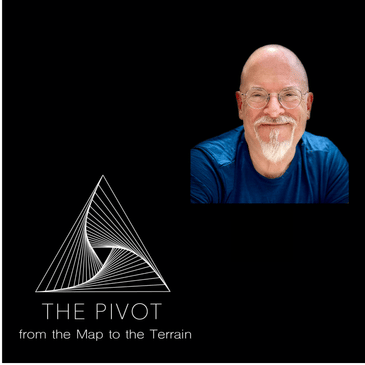
We live in a culture that rewards movement. Answer faster. Decide sooner. Keep going.
But movement and navigation aren't the same thing. You can move all day and still become increasingly lost.
What actually makes navigation possible isn't a better map, more information, or greater confidence. It's something that happens before any of that.
Its orientation. Knowing where you are before deciding where to go.
This is a solo episode recorded during an unexpected pause in the south of France — and an inquiry that's been quietly reshaping how I think about The Pivot itself.
🔗 CONNECT WITH DAVE
Website: daveschoof.com
The Pivot Newsletter: https://tinyurl.com/4vn8832a
Substack: https://dschoof.substack.com
Podcast: https://thepivotpodcast.net/?v=zm7s
LinkedIn: https://www.linkedin.com/in/daveschoof/
[00:00:00] Maybe this is what The PIVOT has been all along. Not complexity, not uncertainty, not even really change. Orientation in the midst of change. Because once you're oriented, you don't need certainty. Welcome to The PIVOT, where we explore the shifts that open new possibilities for how we see, act and navigate the world. Right now, so much is changing faster than we can make sense of.
[00:00:27] It's easy to feel unmoored, caught between an unraveling past and a future that's still, well, taking shape. But there are those who can already see what's emerging, beyond the noise, beyond the confusion. In each episode, I sit down with visionaries, thinkers, practitioners and pioneers who are not just imagining the future, but actually living it. They're sensing what's next and mapping the way forward.
[00:00:57] So if you're wondering how to navigate this shifting landscape, how to stay grounded, adapt and even thrive, you're in the right place. This is not about quick fixes or the seven steps to be more effective. This is about asking the right questions of yourself, of each other, of life. Learning how to make sense of this changing terrain and how to move in it. You don't have to figure it out alone. I've got you covered. This is The PIVOT.
[00:01:27] Welcome. It's just me this week. This week, I wasn't planning to record a podcast. In fact, I deliberately blocked out some space. Not to be productive, not to catch up. Just space. Taking holiday time in the south of France, enjoying the summer weather. Time to think. Time to walk. Maybe even time to do nothing at all.
[00:01:54] But then the day unfolded the way days often do. A message became a phone call. A phone call became a task. That task uncovered something else. Nothing dramatic. Nothing unexpected. Just life. But by late afternoon, I realized the space I'd been looking forward to had quietly disappeared. Now, what struck me wasn't that that happened. It's how easily it happened.
[00:02:23] And how little resistance there was to it. Almost as though the world is constantly inviting us away from ourselves. And that thought has stayed with me. And I decided to share this with you. Because I realized I wasn't actually disappointed about losing the time. There was something else that was bothering me. And it took me some time to find the word. And the word is orientation.
[00:02:50] I've been thinking about that word quite a bit. I did take a walk with it. And it's funny. I've spent years talking about navigation. The pivot. Navigating the metacrisis. Helping leaders navigate uncertainty. Helping people when the old maps stop working. Helping people move through transitions. Yet, somehow, I'd never stop to ask the obvious question. What actually makes navigation possible?
[00:03:21] Because it's not confidence. It's not experience. It's not intelligence. It isn't even having the right map. It's orientation. And this is surprising me. I like this. Sometimes you spend years describing the branches before you finally notice the trunk. And I think that's what's happened to me this week.
[00:03:48] If you've ever spent any time in the wilderness, you know something that our culture often forgets. Imagine you're hiking. At some point, you realize you're no longer entirely sure where you are. Maybe the trail isn't where you expected. Or maybe two paths show up that look almost identical. Or maybe the weather's changed suddenly.
[00:04:14] What's fascinating to me is that experienced navigators don't automatically speed up. They don't think, I'll just walk faster until I figure it out. They stop. They become still. They look. They listen. They notice the light. The contours of the land. The sound of the water. The direction of the wind.
[00:04:42] Only after they've oriented themselves do they move. Somehow we've forgotten that wisdom in everyday life. When we become uncertain, we move faster. It's automatic now. I think we've confused movement with navigation. They're not the same thing. You can move all day.
[00:05:07] You can answer emails, take meetings, listen to podcasts, read another book, sign up for another course, respond to every notification, and still become increasingly lost. That's a strange thing to say in a culture that celebrates busyness. But I think it's true. Movement can create a feeling of progress. Orientation determines whether it's actually taking us somewhere meaningful.
[00:05:39] So what's been sitting with me around this is this. If orientation matters so much, where does it actually come from? Certainly not from consuming more information. We've never had more information. We've never had more experts. More newsletters. More podcasts. More AI. More analysis. And yet, I meet remarkable people all the time who quietly confess, I don't know what matters anymore.
[00:06:10] Now that's not an information problem. That's an orientation problem. I've noticed something about my own life. Some of my clearest thinking has never happened while trying to think. It happens while walking.
[00:06:31] People sometimes ask why I protect that time, what I call spaces between meetings, spaces between things. Why I'm so focused on protecting it. It's not because walking becomes magical. It produces ideas out of thin air. It doesn't. Most walks don't produce anything obvious. But what they do produce is room.
[00:07:00] I've stopped expecting the walk to solve my problems. That was a big shift. Instead, I think of it as creating conditions where something can finally catch up with me. Sometimes nothing happens. Sometimes something I've been carrying for weeks quietly settles into place. Not because I forced it. Because there was finally enough room.
[00:07:30] And I've watched the same thing happen in coaching for years. You know, the breakthrough almost never comes while someone is trying to manufacture one. It comes after... It comes after the sigh. It comes after the silence. After they stop trying to sound competent or in control. Sometimes after they simply say,
[00:07:59] I honestly don't know. It's almost as though inside had been waiting for permission to enter. To enter the room. That's always fascinated me. That's always caught my attention. The most important moments, they rarely arrive through force, if ever. They arrive through availability. And I think this matters now more than ever.
[00:08:28] Because many of us grew up in a world where execution was rewarded. It was demanded and rewarded. The map was relatively stable, predictable, easy. You learn the rules. Work hard. Apply yourself. Refine the strategy. The future was never guaranteed. But it was navigable. Today feels different. Technology is changing faster than our assumptions.
[00:08:58] Artificial intelligence is reshaping work, life, almost monthly, even weekly. Institutions are shifting. Some are disappearing. The pace of change keeps accelerating. Many people I work with aren't asking, how do I optimize? They're asking something much quieter. How do I know what matters now? That's an orientation question.
[00:09:28] As I've been reflecting on this, something else has become clear. Maybe this is what the pivot has been all along. Not complexity. Not uncertainty. Not even really change. Orientation in the midst of change. Because once you're oriented, you don't need certainty. You can move without having every answer. You can tolerate ambiguity, disruption.
[00:09:58] You can discern signal from noise. You can remain connected to yourself while adapting to the world as it's changing. Those capacities all begin in the same place. Orientation. So here's a small experiment I've been trying. When I feel urgency, instead of immediately asking what should I do, I ask a different question.
[00:10:28] I ask, what would help me orient first? Sometimes the answer is a walk. Sometimes it's sitting quietly for 10 minutes. Sometimes it's a conversation. Sometimes it's simply admitting I don't yet know. It's remarkable how often the next step becomes obvious once I'm no longer trying to force it.
[00:10:57] And I've been asking myself another question lately. Not what do I need to accomplish today? But what deserves room today? Room for attention. Room for beauty. Room for grief. Room for uncertainty. Room for imagination. Because I no longer think space is the reward for getting everything done.
[00:11:26] I think space is the condition that allows us to perceive what matters. And perhaps that's the deeper invitation. Not to become faster. Not to become more efficient. But to become better oriented. Because when the map keeps changing, and I suspect it will, we'll need more than information. We'll need the quiet capacity to stop,
[00:11:53] look, listen, feel, and remember where we are before deciding where to go. Thanks for joining me on this inquiry. Until next time, I hope you find a little room this week, not simply to rest, but to orient yourself. This is Dave Schoaf at The Pivot. Go well.
[00:12:26] Thank you for being here, and for staying with what's unfolding. If this conversation opens something for you, I hope you'll carry it forward. And if someone comes to mind who might benefit, trust that and pass it along. If you'd like to continue the exploration, there's a link in the show notes to The Pivot Commons, a free space where these conversations can be explored more directly with others.
[00:12:53] A subscription, a review, a follow are always welcome. It's important because it helps others find their way here to this work. Until next time, keep listening, keep feeling, keep exploring, and keep finding your way. This is Dave Schoaf at The Pivot, where we meet at the edges. Go well. Go well.